Showing posts with label Eve Bunting. Show all posts

Saturday, May 5, 2012

Synthesizing with The Wednesday Surprise

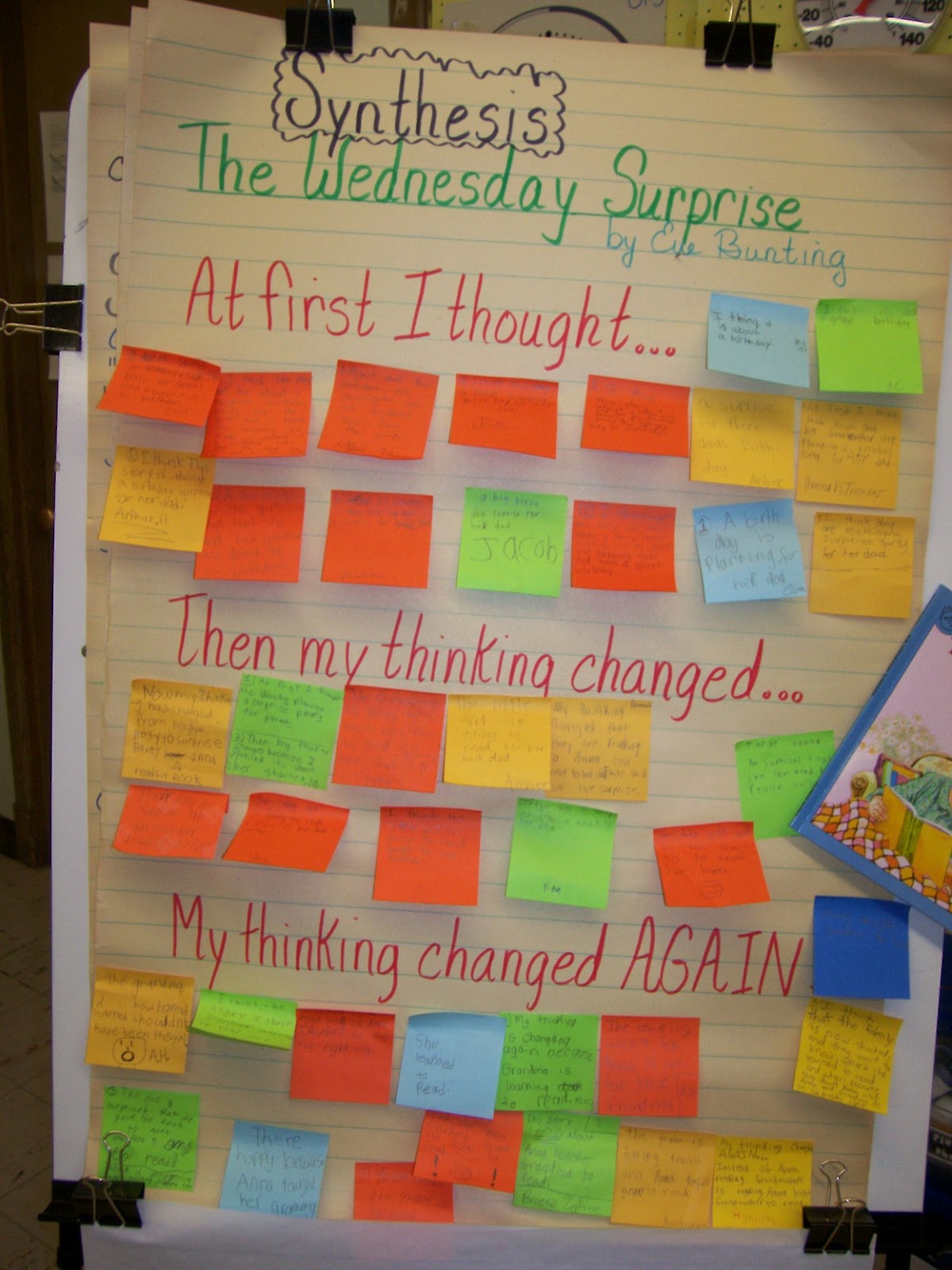
Each year I use The Wednesday Surprise by Eve Bunting to do a lesson on synthesis. Synthesis is when your thinking changes during reading. This book is a great choice because it is short and sweet and your thinking changes quite drastically from the beginning to the end.
 I have taught this lesson for years with only one copy of the book. This year I ordered a class set and it made a big difference. In the middle we start to think  that the main character, Anna, will be reading to her father as his birthday surprise. Synthesizing through this part was the most difficult. I found we had to reread the page three times for full understanding. Having a class set really helped with this. At the end we find out that the surprise is really that the grandmother cannot read. Anna taught her to read and they surprised the father on his birthday. This was a great place it introduce the word: illiterate.
The next day I decided to review those spots in the text when the author either mislead the reader or left us a clue as to what the story was really about. I went through the text and created this worksheet.

We wrote our notes about what was happening to us as  readers on the opposite side. Christine
Saturday, October 29, 2011

Happy Birthday Statue of Liberty!

This week, the Statue of Liberty turns 125! My fourth graders are reading  Lily and Miss Liberty by Deborah Kogan Ray. Its a short historical fiction story which explains how children throughout the country raised pennies to help pay for Liberty's pedestal.
We also read A Picnic in October by my favorite author, Eve Bunting. In true Bunting fashion, she leads the reader to think the birthday party the children are preparing for is for their grandmother, an Italian immigrant. At the end of the story we learn that Grandma and family celebrate Lady Liberty's birthday in front of the statue every year. It's become a family tradition, a way of thanking America for welcoming Grandma when she was a young Italian immigrant.
To add to the fun this week we did a few more projects:

Here I am in my Halloween costume. I don't look bad for 125 yrs old!
Here is an art project we did on the Statue of Libery

Friday, August 20, 2010

Eve Bunting

http://prezi.com/4h_czvbuopkv/eve-bunting/  I have been trying to learn how to use Prezi. What is interesting about it is you can use Prezis that other people have already made. I liked this one especially. Christine

Friday, August 13, 2010

symbols in poetry and stories

Sometimes authors and poets use symbols to deepen the story for the reader. Here is a poster of a lesson I do on Langston Hughes.(He is a recommended poet from our 4/5th grade state standards.) The poem is Mother to Son. Hughes uses a staircase as a symbol in his poem. Eve Bunting uses lots of symbols in her stories. The feather is a symbol in Train To Somewhere.I think it represents Marianne's longing to find her mother. The bird is a symbol of freedom in Fly Away Home. The suitcase is a symbol in Bud, Not Buddy by Christopher Paul Curtis. It stands for everything that is precious to Bud. Caution: Once you introduce the concept of symbols in literature (something that actually represents something else) kids start seeing them everywhere. Christine

I also use this picture book biography on L.H. while we study his poetry. Learning about his childhood helps you understand his poetry. Christine

Saturday, August 7, 2010

Sythesizing lesson


I got this lesson directly out of Debbie Miller's book Reading With Meaning. At first glance the book seems to be written for primary teachers. I've read it a few times and I got a lot out of it for teaching 4th/5th grade.Synthesizing is the most difficult of all of the reading strategies to teach. I really like this lesson because it is easy to see how the readers thinking changes. Those key words: I'm thinking, At first I thought...but now I'm thinking are so important to model with kids. They need to have plenty of experiences with text in which they come across new information and it changes their mind about what is really happening with the characters. I received a class set of Smoky Night by Eve Bunting from Donors Choose so I am able to do this lesson whole group. Christine

Thursday, August 5, 2010

companion books

Eve Bunting is one of my favorite authors. I love to read Train To Somewhere with my class. It is the story of an orphan who is sent on an "orphan train" trom NY to the Midwest in hopes of being adopted. The genre is historical fiction. Orphan trains did really exist in the U.S. in the early 1900's. I really enjoy combining fiction and nonfiction related to the same subject. The story Ophan Train Riders is the perfect companion piece. It is the true story of Lee Nailing, a child who travelled on the orphan trains. You feel like you are with Lee as he travels on his journey in hopes of finding a loving family. You can see from my poster the BIG Question that arises: Why were their so many orphans? Great opportunity for further research but the book does give you the reasons in a clear cut way. Christine


Saturday, July 31, 2010

Donors Choose

I started using Donors Choose few years ago. http://www.donorschoose.com/ I wanted class sets of books that would compliment my curriculum. Donors around the country have to pick your project through the website. You can choose whatever materials you would like and write up a proposal. I teach American History so I chose The Discovery of the Americas by Betsy Maestro. I also use a Social Studies textbook but it is pretty old.This book gives the students so much more detail and the pictures are great. The story of Phillis Wheatley's life fascinates me so I got a class set of the most beautiful book: A Voice of Her Own: The Story of Phillis Wheatley, Slave Poet. This is a great book to practice all of the reading strategies with. She lived in Boston at the time of the Boston Massacre and the Boston Tea Party so it is a terrific choice for teaching the Revolutionary War. I also got three class sets of Eve Bunting books from Donors Choose. Every year I do an author study on Eve Bunting. I particularly like Gleam and Glow, Smoky Night, and Fly Away Home. Not all of my projects have been funded but I have to say I have done very well by Donors Choose. Christine

Saturday, July 10, 2010

revisiting a mentor text

I do an author study on Eve Bunting with my fifth graders. I like to introduce Eve Bunting in November of the fourth grade with this Thanksgiving story, How Many Days To America? I have a class set so this makes it easy. Many times I use the mats and the stickies to help the children make their thinking visible. Its a good book for using all of the reading strategies. It also makes that Thanksgiving connection and expands their thinking about immigration. Recently I got a new idea for this old mentor text from Emily Kissner's blog (its on my blog roll: In My Classroom: The Forest and the Trees). She uses this book for inferring characters feelings. I love the idea of revisiting or working with a book they have already read. This is a great book for inferring the different characters emotions, but I never thought of it that way before I read her post. She starts off the lesson by giving the children examples: How would you feel if you dropped your ice cream cone? How would a dad feel if his daughter crashed the car? ( this brings up the concept of mixed emotions). Then she has the kids work on a linear array for the word angry (upset, frustrated, livid and so on) This is a good vocabulary building exercise. Next, she reads the first page or two of How Many Days To America? and begins a divided page. On the left is the inferred feeling and on the right is the text based evidence. After modeling she has the children work in pairs to come up with some examples on their own. I did this lesson and the kids seemed to really enjoy it. I'd like to come up with some more ways to revisit/reread those really great stories and look at them through another lense.Christine

Saturday, June 12, 2010

make your thinking visible poster

Here is a picture of the poster I use with the lesson in the previous post. After the children have listened to the story and made their thinking visible on the mat, they come up to the poster with their favorite question or inference and add it to the correct column. Christine