Showing posts with label Trophies Anthology. Show all posts

Saturday, October 15, 2011

Baseball poetry

The 4th graders have been reading Lou Gehrig The Luckiest Man  by Alder this week. Its one of my favorite stories in the 4th gradeTrophies anthology. I like to practice the visualizing strategy with this baseball poem after reading the story. It is called Before the Game by Paul Janeczko.The children pick out three different colored highlighters. We then make a key: what can you see, hear, smell or taste while reading  the poem. I typed the poem up on my Smartboard and made a key as well. We also discussed the theme, tone or mood of the poem. Its so evident in that line:                              Joy,                                                                       thick as perfume 
fills the air 
Makes you want to go to a ballgame! Christine

Wednesday, February 2, 2011

Building Background Knowledge

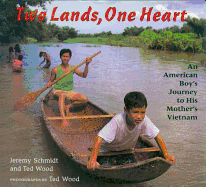
Vietnam is not a topic most fourth graders know much about. The story, Two Lands One Heart is in our Trophies anthology. It is the story of a family separated by war. The mother and son go back to visit family in Vietnam. To acquire background knowledge on the country before we read the story, I like to use this site:
http://www.pocanticohills.org/projects/bestwork.html The work on the website was produced by kids at Pocantico Hills School in Sleepy Hollow, New York. I was able to show the slide show to my whole class on the Smartboard. When you look under their BEST WORK you can also find topics such as:
  • Ben Franklin
  • Abe Lincoln
  • The American Revolution
  • Harriet Tubman
The kids like this because it was written by other children. Christine

Sunday, December 26, 2010

Everglades: 5th grade Trophies

The entire story, Everglades, by Jean Craighead George, is in the fifth grade Trophies anthology. I found a great Storyworks resource to accompany the story.  http://storyworks.scholastic.com/reproducible-archive/november-december-2010 The magazine article , Monsters of the Everglades, can be shown on the Smartboard. The website also has a great short video about invasive species in other places in the US. Storyworks provides worksheets and tests as well. After visiting this website, I am considering buying a subscription for the next school year.

If you don't follow Mary Blow from Scholastic Top Teaching, here is a link to her post. She has a great post on the Storyworks site.
http://blogs.scholastic.com/classroom_solutions/2010/10/magazines-an-english-teachers-best-friend-a-few-years-ago-i-discovered-the-value-of-using-magazines-in-my-classroom.html

This is a vocabulary lesson from the story, Everglades, that I like to use. These words are all synonyms used on page 257 for a large amount.  You could also use a linear array to list the words in a different way. Christine

Monday, October 25, 2010

Webquest

I made my first webquest ever! We are reading Dear Rosa Parks in our 5th grade Trophies anthology, so I made a webquest to increase the students' background knowledge about RP.Here is the link http://lynnwoods.blogspot.com/ It includes two websites and a Youtube video. Christine

Wednesday, September 29, 2010

Donavan's Word Jar

The focus skill for the story Donavan's Word Jar from the 4th grade Trophies anthology  is narrative elements. I particularly like this story because it has more than one problem. The main problem is that Donovan has too many words in his word jar, but the story also has a smaller problem, a conflict between two characters. Both problems have different solutions. I got this poster directly out of the TE. I give the children a paper copy and we divide it in half  (problem #1 and problem #2). Its a great introduction to the concept that stories can have more than one problem. Compromise is also a vocabulary word for the week. I like that it is also the solution to one of the problems.   Christine

Sunday, September 19, 2010

teaching the Iditarod

Our fifth grade Trophies anthology has two stories related to the Iditarod: Woodsong by Gary Paulsen and Iditarod Dream by Ted Wood. I like to use two other picture books written by Robert J. Blake: one story is called  Togo and the other one is Akiak. Both stories have the same themes: determination, courage and the refusal to give up against incredible odds.Togo had an important role in the Great Serum Race which is the inspiration for the Iditarod (unfortunately,Balto gets all the credit). Akiak was determined to win the Iditarod and at ten years old he did: fighting injury, bad weather and rules that would have prevented him from continuing. Both stories have excellent maps to show the dog's journey and the pictures are incredible. Christine

Tuesday, August 31, 2010

Trophies grade four

Here is a poster for The Gardener, the first story in the 4th grade Trophies anthology. The focus skill is narrative elements. I copied this poster directly out of the TE. It is interactive (Velcro is stuck to the back). I think I would also use my retell glove to emphasize major and minor characters ( why are they major, why are they minor). I would also discuss who is the narrator and from whose point of view is the story being told.  Setting: time and place. Have them give text based evidence for both. Time is confusing here because of the genre. The story is told in letters. You have to pay careful attention to the dates above the letters to know when the events are happening (picture clues are also helpful). Problem: the conflict in this story is character against society ( the Great Depression causes the major event). Solution: the solution is interesting. You could say making Uncle Jim smile, but I also think the solution is making the best of a difficult situation. Lydia shows a positive attitude and it makes all the difference. The solution is tied up with the theme of the story. Christine

Friday, August 20, 2010

chapter books for the coming year

I like to have my 5th graders read at least 10 chapter books during the school year. Sometimes we read these stories in class and sometimes we read them for homework a few chapters at a time. I think I have decided on at least 9 for the coming school year:
  1. Among The Hidden. It has been a frantic search this summer to collect a class set but I think I will have enough books. If I can get them hooked on the first book in the series, many kids will want to read all 7 books. (Science fiction)
  2. The Cay. Thank you Deb for recommending this to me a few years back. (Historical Fiction)
  3. Tuck Everlasting. This is a great book to use to apply all of the reading strategies. (Fantasy)
  4. Shiloh Always a class favorite (realistic fiction)
  5. Shiloh Season (realistic fiction)
  6. Yang The Third and Her Impossible Family An excerpt is in our Trophies but I prefer to read the whole book. Very funny. (realistic fiction)
  7. Bud, Not Buddy (historical fiction)
  8. Island of The Blue Dolphins  An excerpt is in our Trophies but again I'd rather read the whole thing.(historical fiction)
  9. Number The Stars (historical fiction)
  10. ????
As you can see my list is a little lopsided towards historical fiction. Christine

Thursday, August 19, 2010

more on summarizing

This is my poster for summarizing the story How To Babysit an Orangutan in the 4th grade Trophies book. You can see that it is interactive.We build the summary together during class. (I used velcro after laminating the strips to attach them to the poster. ) All of these posters are hung on top of each other for easy storage. You can see the red hooks at the top of the picture. I tried to take the focus skill from each story and make an interactive poster for teaching the lesson. I got many of my ideas for the posters right out of the teaching manual. Although it was a lot of work at the beginning, I have used them for many years now and they are so easy.Christine

Wednesday, August 18, 2010

Main idea and supporting details

Here is another lesson from 4th grade Trophies. The story is The Kids' Invention Book. The focus skill for the story is main idea and supporting details. We "build" the poster together after having read the story. You can see that the poster has the answers velcroed on which makes it interactive. I have done this with many of the focus skills from the stories in Trophies for grade 4 and a few for grade 5. Christine

Tuesday, August 17, 2010

Trophies lessons

Lou Gehrig: The Luckiest Man By David Adler is in the 4th grade Trophies anthology. I like this lesson to teach summarizing. I have the kids do a timeline of Lou's life using the dates in the story. You can see from the poster that we picked eleven important dates and put them in the order in which they happened (using a sticker for each one.) Next they write the events in paragraph form. It is important to talk about what is missing. I ask them, "Can you think of any other IMPORTANT details that would need to be in the summary that were not on the timeline?" I have them search out three or four other important details and write them on stickies. (determining importance reading strategy). Christine

Thursday, July 8, 2010

character traits

What kind of a person is_____________? Use evidence from the text to support your answer. This is a typical open response question on the MCAS for grades 3-5. I use this laminated poster to teach character traits throughout the year. This story, In The Days of King Adobe, is in our 4th grade Trophies anthology. The words thrifty and rascally are actually vocabulary words for the story. I have a character traits poster hung up in the room for reference. It is also a great vocabulary builder because some of the words on it  are challenging like mischievous or timid. Christine

Saturday, June 5, 2010

Inference lesson


Sarah, Plain and Tall was never a favorite children's book of mine until I really started applying the reading strategies while reading it with kids. Our grade 4 Trophies (Houghton Mifflin) Anthology has an exerpt, but I would rather read the whole book. The poster shows the lesson "read between the lines" from the first letter Sarah writes to Papa to introduce herself. To grasp what Sarah is really saying you need to have some pretty solid inferencing skills. We as adults clearly pick up on some of Sarah's character traits, but children do not. They have no background knowledge about what it is to be a mail order bride. Words like spinster and old maid may be foreign to them. After this lesson, the children are better equipped to continue with the story. I sometimes have them finish the story and summarize a few chapters a night for homework. If you are interested in building background knowledge about the prairie or pioneers before reading, I would recommend Dandelions by Eve Bunting or Dakota Dugout . Christine