Showing posts with label questioning. Show all posts

Friday, November 18, 2011

More on Chris Van Allsburg


I love reading The Stranger and The Sweetest Fig by Van Allsburg. with children, but I have never used The Mysteries of Harris Burdick before. Some Van Allsburg books take some time to "get". I didn't like The Stranger the first time I read it, but now it is one of my favorite books. The Mysteries of Harris Burdick is just a group of unconnected pencil drawings, each with a title and an introductory sentence.Here is an example:
It all started when someone left the window open....
The reader is left to wonder what happens next. Its a great book to use with young writers who have great imaginations. Questions instantly come to mind: Who left the window open? Why? Is that bird on the wallpaper coming to life? 

The Chronicles of Harris Burdick was recently published. It is like an answer key for those pencil drawings. A short story was written for each of the drawings by famous authors like Louis Sachar and Stephen King. I couldn't wait to read it and share it with some of my young writers with great imaginations. Here is a website to explore more if you are interested:
Christine

Wednesday, October 26, 2011

More on The Stranger

My original post from 2010: My two favorite Van Allburg books are The Stranger and The Sweetest Fig. The Stranger is a great book to use when teaching inferring. You can see from my poster that I start with: I think the stranger is.... and Here are the clues (details) that helped me:  I put a sticky over the answer. As we read the book I had the children make their thinking visible on post it notes and then stick them to the page.We developed the list on the anchor chart together. Many children are able to understand that something unusual or magical is happening but they don't have the background knowledge to come up with the name Jack Frost.
            This year as I was reading The Stranger to my class I started thinking how much our questions  lead us to understanding who the stranger really is. I produced this new anchor chart with the 4th graders.  I combined parts of the text with the post it notes where the children made their thinking visible. Here are some pictures:


Sunday, May 22, 2011

An introduction to Anne Frank

After reading Number the Stars by Lois Lowry, I like to introduce my 5th graders to Anne Frank. David Adler's picture book biographies are excellent. The one he wrote about Anne is particularly wonderful. It is a beautiful introduction to a difficult but important story that fifth graders a ready to learn a little bit about. I explain that most middle school/high school students are expected to read The Diary of Anne Frank as a class assignment. This is just an introduction.
   The lesson goes as follows: I ask the students to fold a piece of paper into a mini "file". (This represents the file cabinet we have in our heads, our background knowledge.) On the front we make our thinking visible by writing everything we know about Anne Frank. Some students have never heard of her before, their file cabinets are empty and we are about to fill them up. Inside we write all of the questions we have about her BEFORE reading. Then we partner read the David Adler picture book, I have a class set. Next, we write all of the questions we have AFTER reading the book. On the back of the file folder we write a summary of the story. A class discussion follows regarding the questions that came up as they read. I have a collection of books written for elementary age students that I share with them after this experience. Christine 

Saturday, April 2, 2011

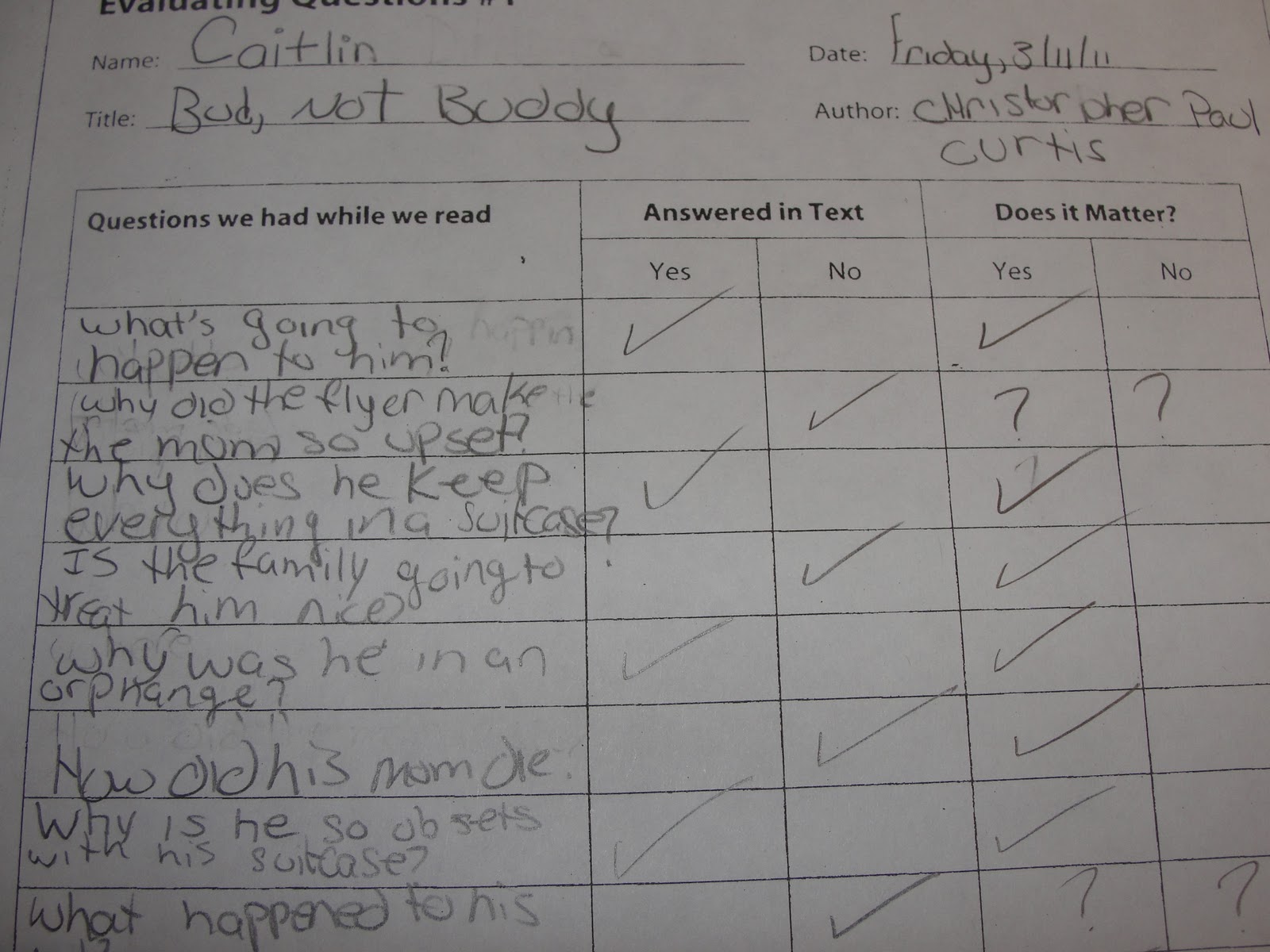
Bud, Not Buddy

How does an author get us hooked on a book? Questions! After reading the first chapter of Bud, Not Buddy by Christopher Paul Curtis we brainstormed questions we had. We discussed how the author embedded certain details in chapter one that would activate our questioning strategy. Authors do this to push us forward, to entice us to keep reading.
I like to use this worksheet to record questions on.  The student has to think about whether or not the questions were answered in the text...and does it matter to them as the reader. Christine

Tuesday, January 18, 2011

See The Ocean

http://www.dayofreading.org/DOR09HO/Teaching%20the%20Skill%20of%20Inference.pdf I love the story See The Ocean by Estelle Condra. I found a great link to the whole story in a power point presentation on inferencing by Rebecca Binks. I like to use See The Ocean to teach questioning but you could certainly argue that it is a good book to use for teaching inferencing as well. The story starts on page 33 (it takes a minute  or two to download)of the power point, but you may be interested in looking at the whole slide show. Christine

Friday, July 23, 2010

reciprocal teaching

I made a bunch of these posters for group work after reading Reciprocal Teaching At Work by Lori Oczkus. She uses the formula: predict, question, clarify and summarize in small group instruction. I like to use this idea with groups of 2-4 kids. Each child gets to pick a box or two to write in but all of the work has to be done as a group. The lesson on the poster was from a nonfiction article in National Geographic for Kids called Our Oceans. Before I had the children open the magazine I told them the topic (oceans) and had them do the top of the poster: What do you know about...After they have brainstormed I had them open up to the article and predict what it will be about by doing a 10, 9, 8....(I count backwards slowly while they do a sort of picture walk to look for clues in the text features as to what the article might be about.) Next they read the article as a group and fill in the section that asks what questions came to mind as they read, and the section marked clarify   which is the vocabulary piece ( they have to list the word they didn't know, the definition of the word, and how they figured it out). Lastly they summarize  the article. The part they love about this lesson comes after it is complete. I give every child in the group a sticky and ask them to privately write the name of the person in their group who worked the hardest. Everyone wants their name on that sticky. Its a great motivator for many kids. Sometimes I even give them a "grade" for how well I think they worked together. Lori Oczkus also wrote Interactive Think Aloud Lessons. I liked that book as well. Christine

Wednesday, July 7, 2010

Titanicat

The Titanic story fascinates me. This book is interesting because it gives us a different perspective of the story...The point of view of a cat and a poor immigrant boy named Jim who works on this grand ship.
Questions abound as we read the story. We have to infer to understand what is really going on. I put three questions on the board to help us gather information. 1. What do we learn about Jim? 2. What do we learn about the cat? 3. What do we learn about ships and cats?As we read the story I keep adding to the chart. After awhile we review the information and make some inferences and predictions for what will come next. For some children this story sparks and interest in reading further about the Titanic. I have a collection of books on the subject that I leave out. Look at my post on inferring vocabulary words in context to see another lesson I did with Titanicat.Christine

Saturday, July 3, 2010

picture books for teaching social studies

I have used Katherine Kirkpatrick's historical fiction picture book Redcoats and Petticoats while teaching the American Revolution for the past few years. Its a wonderful book about a young boy who unwittingly becomes part of a spy ring. The questioning strategy is activated frequently while reading this book. Why is mother doing so much laundry? Why is she acting so strange? Didn't she just wash those same petticoats yesterday? I have the children use the mats I made (previous post) and stickies to make their thinking visible as I read the story to them. After reading we go back and look for all of the clues the author gave us that show what is really going on (its a patriot spy ring ). The kids love this book. Its a fifth grade favorite.Christine

Saturday, June 12, 2010

make your thinking visible poster

Here is a picture of the poster I use with the lesson in the previous post. After the children have listened to the story and made their thinking visible on the mat, they come up to the poster with their favorite question or inference and add it to the correct column. Christine

Friday, June 11, 2010

Make your thinking visible


After I have taught the following reading strategies: background knowledge, visualizing, inferring, and questioning I start using these mats. I tell the children to "make their thinking visible" by writing down on stickies what is going on in their brains while I read a story aloud. Excellent readers use all of the strategies simultaneously, therefore I have them practice in a way that allows me to assess their ability to read critically. We are now fully into the apply stage. Next, I might ask them to tell me what they visualized or questioned and go up to place their stickies on a poster for the whole class. I use these posters/mats all year (probably once or twice a month)for whole group instruction. I have even given them a worksheet that looks like the mat for homework to use with their nightly reading (instead of summarizing the chapter). Christine

Thursday, June 3, 2010

Questioning


Simply put: If you don't have any questions...stop reading the book. Questions drive us to read further. They are the engine! As I became more aware of the strategies in my own reading, I was amazed at the type and the amount of questions I had. In class I love to say the words...."Hmm, I wonder" or "My questioning strategy was just ACTIVATED here" while we are reading together. Questions are powerful. They engage us and make us wonder what the answers are. Asking questions is natural for children. The tough part is trying to get them to ask deep questions about the characters they meet in books. Why did the character say that/do that? (characters motivations). I love Charlie Anderson and See the Ocean for a first experience with questioning. Both books have that little twist at the end that makes you think. Christine