Showing posts with label grade 4. Show all posts

Sunday, November 4, 2012

Class Dojo

My teaching partner started using Class Dojo with the 4th and fifth graders this year. It is an online behavior management program that teachers can use for free! http://www.classdojo.com/Students earn and get dojo points taken away for a variety of reasons. The teacher can choose what they want the class to work on: On task behaviors, persistence, working together and so on. I partnered this program with another one calledfitnessfinders.net This company had awards or charms in increments of 25. Once one of our students earns 25 dojo points they get a necklace, a dog tag, and a 25 "dojo" charm.

Our Dojo necklaces!

This company gives out lots of free samples of many different charms. The possibilities are endless! Christine

Sunday, October 21, 2012

ELA Notebooking


Interactive notebooking is really interesting. I learned about it from some different blogs: The Middle School Mouth and A Teacher's Treasure. Here is my Pinterest board with links to the various sites: http://pinterest.com/cjken42/ela-notebooks/ 
The first page of the fiction section  is a reading log


The inside cover of the 4th grade notebook looks like this. You can see the poster that we used as inspiration. Our essential question was: Why do authors write stories?

On another page (this is is the fifth grade notebook) we log in the conflict of the various stories we read. You can see that we make it interactive by placing a picture of the  story on the conflict poster, This stays up all year.

Here is another page in the 5th grade notebook that is also interactive. We log the point of view of each story in our notebooks and on the poster.

I have started to add foldables to our ELA notebooks. Here is one on similes. This is fun but it is also a work on progress. I originally put three tabs in the notebooks: fiction, nonfiction and language. I wasn't sure where I wanted to put similes. It ended up in language. My long term plan is that the students use the notebooks as a resource. We have glued in other pages like these one that lists sample character traits. Whenever they need a trait they could look at this page. Christine

Sunday, August 5, 2012

4th Grade Mini Lesson

Life in 4b has been one of my favorite blogs to follow. Miss Bonkers in moving on up to middle school. I can only hope she keeps sharing her wonderful lessons with us. Here is a video of her using one of my favorite mentor texts with the famous Ike Larue. Christine

Wednesday, June 13, 2012

Common Core book picks

The appendix to the Common Core has an interesting  list of books you could use to teach the new standards. I really liked this nonfiction pick: Toys! Amazing Stories Behind Some Great Inventions. by Don Wulffson. I used Youtube videos to introduce a few of the the different inventions: the slinky, magic rocks, and Mr. Potato Head. These are posted at the bottom. After reading each individual story I had the students work on this worksheet I created:
They had to record the name of the invention, the inventor, when and where they invented it, what inspired him/her, and a problem the inventor encountered. The last block was a place to record a trait or characteristic we noticed that the inventor had. For example: creative, hardworking, intelligent. Most of the stories in the book Toys! follow this pattern. Later on in the week we worked in groups to prove that inventors have common characteristics.
I used those large stickers to have the groups  record text based evidence of inventors showing that they were smart, persistent, creative or hardworking. The kids really liked this book. The stories are short. You could read 2-3 in a period. They could also be easily summarized.
  • RI.4.1. Refer to details and examples in a text when explaining what the text says explicitly and when drawing inferences from the text. (We had to infer common traits of inventors)
  • RI.4.2. Determine the main idea of a text and explain how it is supported by key details; summarize the text.
  • RI.4.3. Explain events, procedures, ideas, or concepts in a historical, scientific, or technical text, including what happened and why, based on specific information in the text
RI.4.7. Interpret information presented visually, orally, or quantitatively (e.g., in charts, graphs, diagrams, time lines, animations, or interactive elements on Web pages) and explain how the information contributes to an understanding of the text in which it appears. ( Some of the info from the Youtube video on the invention of the slinky conflicted and/or added to the information we learned from the text)
RI.4.10. By the end of year, read and comprehend informational texts, including history/social studies, science, and technical texts, in the grades 4–5 text complexity band proficiently, with scaffolding as needed at the high end of the range.

Mr. Potato Head


Richard T. James the Slinky Inventor --


Tuesday, May 15, 2012

Common Core Persuasive Writing Lesson

I love the book Should Their Be Zoos? by Tony Stead. I've written about my lessons using this book in previous posts. . Recently I found a writing lesson which is aligned to the common core that I want to share with you. The students write an opinion piece and support their point of view with reasons from the text Should Their Be Zoos,and The Swazi Eleven by Kelly Boland.(A copy of this article is given in the packed from the link below). They also use facts learned from  a video clip from a Phoenix news station about an endangered animal which has thrived at a local zoo. I posted a copy of the video I found on Youtube below. Here is the link to the NYC Dept. of Education website:
http://schools.nyc.gov/NR/rdonlyres/C03E352F-F0EE-4152-8CBE-76F1D62864F5/0/NYCDOEG5Literacy_TCRWP_Final.pdf


Common Core Standards addressed:RI.5.1 Quote accurately from a text when explaining what the text says explicitly and when drawing
inferences from the text.
RI.5.2: Determine two or more main ideas of a text and explain how they are supported by key details;
summarize the text.
RI.5.10: By the end of the year, read and comprehend informational texts, including history/social studies,
science, and technical texts, at the high end of the grades 4–5 text complexity band independently and
proficiently.
W.5.1: Write opinion pieces on topics or texts, supporting a point of view with reasons and
information.

Phoenix Zoo


Saturday, May 5, 2012

Synthesizing with The Wednesday Surprise

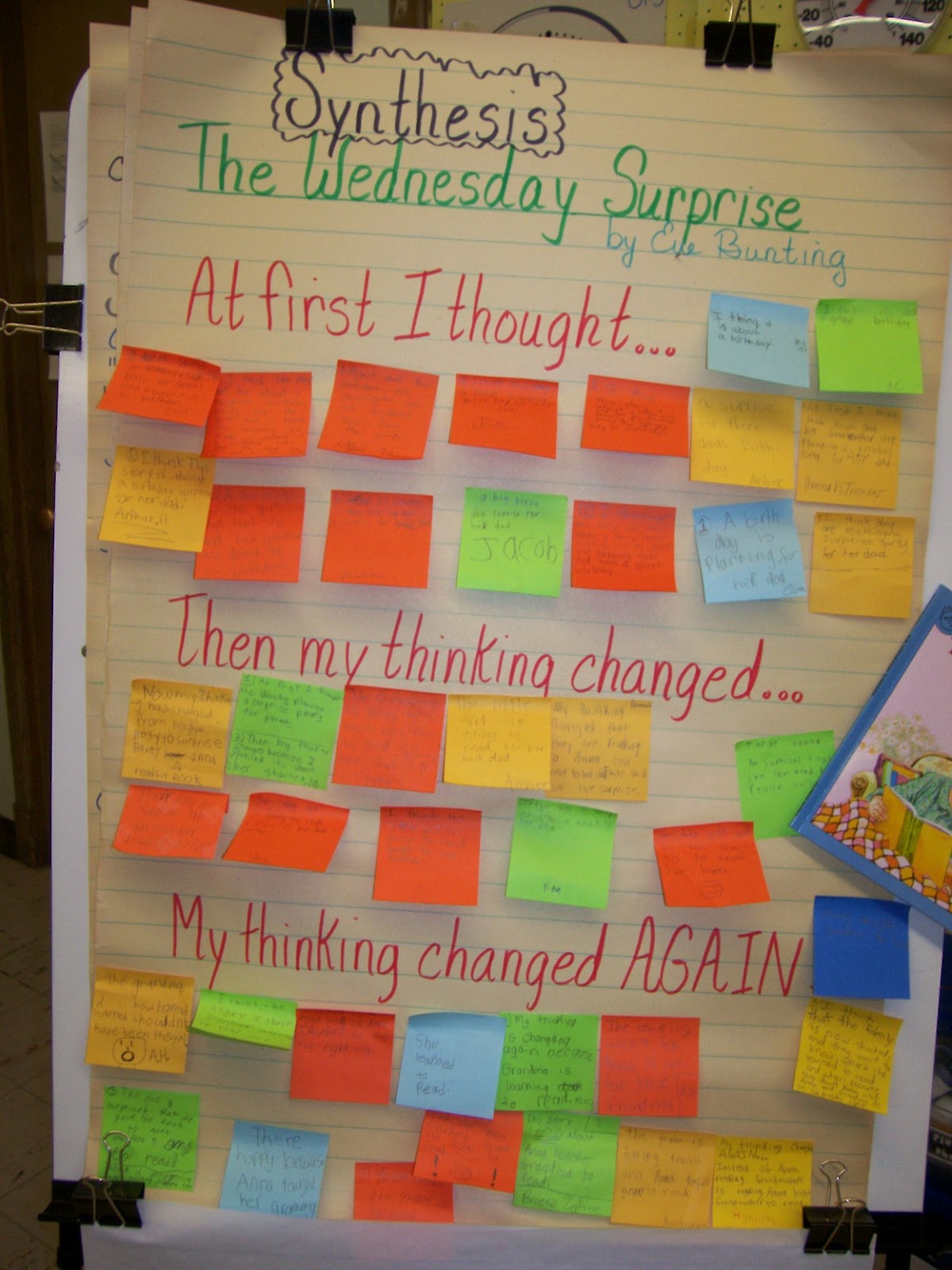
Each year I use The Wednesday Surprise by Eve Bunting to do a lesson on synthesis. Synthesis is when your thinking changes during reading. This book is a great choice because it is short and sweet and your thinking changes quite drastically from the beginning to the end.
 I have taught this lesson for years with only one copy of the book. This year I ordered a class set and it made a big difference. In the middle we start to think  that the main character, Anna, will be reading to her father as his birthday surprise. Synthesizing through this part was the most difficult. I found we had to reread the page three times for full understanding. Having a class set really helped with this. At the end we find out that the surprise is really that the grandmother cannot read. Anna taught her to read and they surprised the father on his birthday. This was a great place it introduce the word: illiterate.
The next day I decided to review those spots in the text when the author either mislead the reader or left us a clue as to what the story was really about. I went through the text and created this worksheet.

We wrote our notes about what was happening to us as  readers on the opposite side. Christine

Friday, April 13, 2012

Learning about the Titanic


The 100 year anniversary of the sinking of the Titanic is tomorrow. Scholastic had the first book of the I Survived..... series on sale for $1.00 a piece! What a great book! Both the 4th and 5th graders thoroughly enjoyed reading it.We started learning about the Titanic with an article in Weekly Reader. The more I use Weekly Reader the more impressed I've become. I'm always looking for nonfiction sources with great text features. This month WR had an awesome map/timeline of the sinking of the Titanic. I also found some great Youtube videos about the Titanic to use in class. After we finished I Survived The Sinking of  The Titanic we had to write a two word summary. Here is a picture of the poster we made together.
Some children chose words that described George, the main character, others chose words  to describe the feelings they had while reading the book. A few children felt an object from the story or a theme was most important. Coming up with only two words to describe a whole book can be challenging!
We also spent some time reading about the Costa Concordia that sank off the coast of Italy in January in an old WR edition.. The article gave us lots of room for comparison to the Titanic. It also had another great map to help us visualize what exactly happened to that ship.
If your students are very interested in the Titanic and you are looking for even more resources,
http://www.wegivebooks.org/books has the book Titanic Sinks! available to read online for free.  Christine

Sunday, March 4, 2012

Learning about owls

This is the bulletin board I made for our owls unit. The big owl in the middle is actually a kite I found in a toy store many years ago. My favorite book that I have used for teaching about owls is Owls by Eric Weiner. I like it because the new vocabulary words like talons and species are in italics and the definitions are embedded in the text. Unfortunately it seems to be out of print. Here are some other great books for teaching about owls. Christine

Sunday, February 26, 2012

Owl Pellets

This was such a find! While dissecting owl pellets this year we watched this great Youtube video on the Smartboard.
On the same day in the computer lab we did a virtual owl pellet dissection using http://www.kidwings.com/index.htm I love this site!

Monday, February 6, 2012

Reading Rainbow:


I've been having soooo much fun using Youtube in my classroom. My latest adventure involves Reading Rainbow. I remember this series from when I was a kid. The books are read aloud while you view pictures from the story. Many of the books presented are award winners. I've been able to connect many of them to my curriculum. Here are a few of my favorites:

Reading Rainbow: Kate Shelley & the Midnight Express


Sunday, January 1, 2012

Teaching about flashbacks

A few years back my 4th graders completely misinterpreted the meaning of a text because they didn't understand that the character was now explaining something that had happened long ago. Flashbacks can be confusing to the reader. I really like The Summer My Father Was Ten by Pat Brisson as a mentor text for teaching  about flashbacks.
I got this book from Teaching for Deep Comprehension by Linda Dorn. The teaching resource has a DVD which shows a 4th grade teacher modeling how to use the book. Also, I really recommend this blog: Life in 4B http://lifein4b.blogspot.com/2011/12/were-baaaack.html if you don't already follow it. Its been a great resource for me for the last few years. A few weeks ago I was reading Sarah Plain and Tall with my 4th graders. I like using the story Dakota Dugout after reading Sarah Plain and Tall and then comparing the two stories. I got the idea for using Dakota Dugout to teach about flashbacks from Miss Bongers at Life in 4B.
If you have any great suggestions about what books to use to teach children about flashbacks let me know. Christine

Friday, December 30, 2011

Patricia Polacco

I love stories that show how a character changes. Mrs. Mack by Patricia Polacco is a great example of this. I got the idea for this lesson from a great blog: Get In The Fold http://getinthefold.blogspot.com/2011/11/why-we-love-patricia-polacco.html I had the 4th and 5th graders make the foldables prior to reading the book. We read up to page 14 and then completed the questions on the left side of the foldable:
  • What did Patricia do?
  • What did Patricia think or feel?
  • How did others respond to her?
  • How did she look?
After we finished the story we answered the same questions on the other side of the foldable.
The Get in the Fold blog has much better pictures that I do of what the inside looks like. After finishing the left and right sides of the foldable we worked on the inside sheet:
It includes three major events from the story and how Patricia reacted and how others responded. I narrowed down the major events in the story and put them on the above poster. This sheet gets tucked inside the foldable. This was a great activity for that week before Christmas. After we finished them I had the kids decorate the covers. Many of the students got interested in my collection of  Patricia Polacco books after reading Mrs. Mack. Christine

Saturday, October 29, 2011

Happy Birthday Statue of Liberty!

This week, the Statue of Liberty turns 125! My fourth graders are reading  Lily and Miss Liberty by Deborah Kogan Ray. Its a short historical fiction story which explains how children throughout the country raised pennies to help pay for Liberty's pedestal.
We also read A Picnic in October by my favorite author, Eve Bunting. In true Bunting fashion, she leads the reader to think the birthday party the children are preparing for is for their grandmother, an Italian immigrant. At the end of the story we learn that Grandma and family celebrate Lady Liberty's birthday in front of the statue every year. It's become a family tradition, a way of thanking America for welcoming Grandma when she was a young Italian immigrant.
To add to the fun this week we did a few more projects:

Here I am in my Halloween costume. I don't look bad for 125 yrs old!
Here is an art project we did on the Statue of Libery

Wednesday, October 26, 2011

More on The Stranger

My original post from 2010: My two favorite Van Allburg books are The Stranger and The Sweetest Fig. The Stranger is a great book to use when teaching inferring. You can see from my poster that I start with: I think the stranger is.... and Here are the clues (details) that helped me:  I put a sticky over the answer. As we read the book I had the children make their thinking visible on post it notes and then stick them to the page.We developed the list on the anchor chart together. Many children are able to understand that something unusual or magical is happening but they don't have the background knowledge to come up with the name Jack Frost.
            This year as I was reading The Stranger to my class I started thinking how much our questions  lead us to understanding who the stranger really is. I produced this new anchor chart with the 4th graders.  I combined parts of the text with the post it notes where the children made their thinking visible. Here are some pictures:


Saturday, October 15, 2011

Baseball poetry

The 4th graders have been reading Lou Gehrig The Luckiest Man  by Alder this week. Its one of my favorite stories in the 4th gradeTrophies anthology. I like to practice the visualizing strategy with this baseball poem after reading the story. It is called Before the Game by Paul Janeczko.The children pick out three different colored highlighters. We then make a key: what can you see, hear, smell or taste while reading  the poem. I typed the poem up on my Smartboard and made a key as well. We also discussed the theme, tone or mood of the poem. Its so evident in that line:                              Joy,                                                                       thick as perfume 
fills the air 
Makes you want to go to a ballgame! Christine