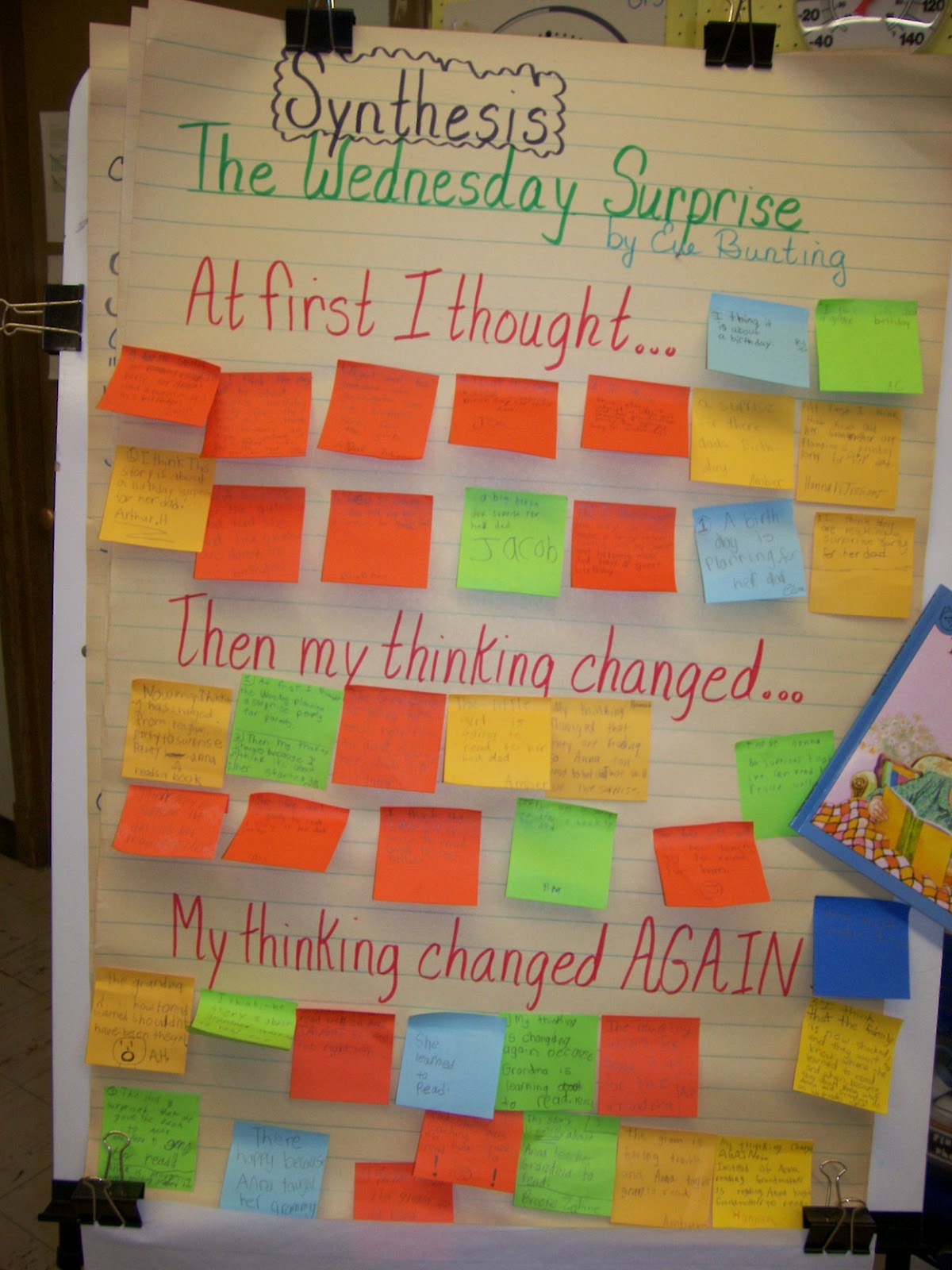
Each year I use The Wednesday Surprise by Eve Bunting to do a lesson on synthesis. Synthesis is when your thinking changes during reading. This book is a great choice because it is short and sweet and your thinking changes quite drastically from the beginning to the end.
I have taught this lesson for years with only one copy of the book. This year I ordered a class set and it made a big difference. In the middle we start to think that the main character, Anna, will be reading to her father as his birthday surprise. Synthesizing through this part was the most difficult. I found we had to reread the page three times for full understanding. Having a class set really helped with this. At the end we find out that the surprise is really that the grandmother cannot read. Anna taught her to read and they surprised the father on his birthday. This was a great place it introduce the word: illiterate.
The next day I decided to review those spots in the text when the author either mislead the reader or left us a clue as to what the story was really about. I went through the text and created this worksheet.
We wrote our notes about what was happening to us as readers on the opposite side. Christine
SEARCH FOR:
all the reading strategies
(9)
background knowledge
(6)
Beth Newingham
(6)
character traits
(5)
Common Core
(8)
Eve Bunting
(9)
favorite books
(49)
favorite websites
(21)
Favorite Youtube videos
(5)
genre
(6)
grade 4
(47)
inferring
(19)
making connections
(4)
MCAS
(8)
Miss Alaineus
(3)
narrative elements
(14)
paperback swap
(1)
persuasive writing
(1)
poetry
(10)
point of view
(4)
professional books
(14)
questioning
(11)
show don't tell
(1)
SMARTboards
(24)
spelling
(1)
summarizing
(5)
synthesis
(3)
technology
(11)
text features
(3)
text structure
(1)
Trophies Anthology
(13)
visualizing
(5)
vocabulary instruction
(13)
writing
(10)
Total Pageviews
Saturday, May 5, 2012
Sunday, April 29, 2012
Another book pick for the Common Core
I ordered a class set of this wonderful picture book/biography, Irena's Jar of Secrets by Marsha Vaughan to add to my nonfiction collections. It is the story of a young girl who grew up Catholic in Poland. She became a social worker who bravely rescued 2,500 Jewish children from the Nazis. The names and locations of the children where kept in a jar which she hid under a apple tree. Irena Sendler lived to the ripe old age of 98!
This picture book is not for young children due to the topic. It will be a great addition to my lessons surrounding Number The Stars by Lois Lowry. Now I will have that (historical) fiction/nonfiction (biography)connection.
Here are some of the Common Core standards we will be working on with this book:
- RI.5.1. Quote accurately from a text when explaining what the text says explicitly and when drawing inferences from the text.
- RI.5.2. Determine two or more main ideas of a text and explain how they are supported by key details; summarize the text.
- RI.5.3. Explain the relationships or interactions between two or more individuals, events, ideas, or concepts in a historical, scientific, or technical text based on specific information in the text.
Saturday, April 28, 2012
Learning about Honey Bees
I've picked out a few class sets to help me teach the new common core standards. The Hive Detectives: Chronicle of a Honey Bee Catastrophe by Loree Griffin Burns is one of them. Many years ago I met a bee keeper and that started my fascination with honey bees. In the last ten years millions of honey bees have been found dead or have vanished without a trace. This book delves into the mystery about what is actually happening to the honey bees and why it is important to us all.
The new common core standards push for an increase in reading informational text in elementary school. I am going to use this book to teach these standards:
- RI.5.4. Determine the meaning of general academic and domain-specific words and phrases in a text relevant to a grade 5 topic or subject area. (the book has an excellent glossary to help us as well.)
- RI.5.5. Compare and contrast the overall structure (e.g., chronology, comparison, cause/effect, problem/solution) of events, ideas, concepts, or information in two or more texts. (Their are at least two structures present: chronological and problem/solution)
- RI.5.1. Quote accurately from a text when explaining what the text says explicitly and when drawing inferences from the text.
- RI.5.2. Determine two or more main ideas of a text and explain how they are supported by key details; summarize the text.
Friday, April 13, 2012
Learning about the Titanic
The 100 year anniversary of the sinking of the Titanic is tomorrow. Scholastic had the first book of the I Survived..... series on sale for $1.00 a piece! What a great book! Both the 4th and 5th graders thoroughly enjoyed reading it.We started learning about the Titanic with an article in Weekly Reader. The more I use Weekly Reader the more impressed I've become. I'm always looking for nonfiction sources with great text features. This month WR had an awesome map/timeline of the sinking of the Titanic. I also found some great Youtube videos about the Titanic to use in class. After we finished I Survived The Sinking of The Titanic we had to write a two word summary. Here is a picture of the poster we made together.Some children chose words that described George, the main character, others chose words to describe the feelings they had while reading the book. A few children felt an object from the story or a theme was most important. Coming up with only two words to describe a whole book can be challenging!
We also spent some time reading about the Costa Concordia that sank off the coast of Italy in January in an old WR edition.. The article gave us lots of room for comparison to the Titanic. It also had another great map to help us visualize what exactly happened to that ship.
If your students are very interested in the Titanic and you are looking for even more resources,
http://www.wegivebooks.org/books has the book Titanic Sinks! available to read online for free. Christine
Labels:
favorite books,
favorite websites,
grade 4,
summarizing
Thursday, March 29, 2012
Infer a character's feelings
I have a class set of Mildred Pitts Walter's Ty's One Man Band. Recently we used it to practice inferring how a character feels. We studied Ty's thoughts, actions and words to figure out his emotions. This objective is very clearly written in the new Common Core standards for fourth graders. This text is rather simple so it is a good choice when working on such a complex skill.

Here is the poster I made for the reading lesson. On the left I put copies of pages from the story where Ty was feeling a certain emotion. (I highlighted the evidence.)
This is the worksheet I used. You can see that the students had to locate the feeling or emotion ( I gave them the page numbers). Later we added the stickies with the information about which emotion he felt and the way it was revealed to us to the poster. Youtube has the story Ty's One Man Band in a Reading Rainbow episode. We were able to watch it on the Smartboard. See it below. Christine
Here is the poster I made for the reading lesson. On the left I put copies of pages from the story where Ty was feeling a certain emotion. (I highlighted the evidence.)
| On this page Ty is curious. You can see that he is hiding from the mysterious stranger. |
Sunday, March 4, 2012
Learning about owls
This is the bulletin board I made for our owls unit. The big owl in the middle is actually a kite I found in a toy store many years ago. My favorite book that I have used for teaching about owls is Owls by Eric Weiner. I like it because the new vocabulary words like talons and species are in italics and the definitions are embedded in the text. Unfortunately it seems to be out of print. Here are some other great books for teaching about owls. Christine
Subscribe to:
Posts (Atom)


